Audio Homework 1
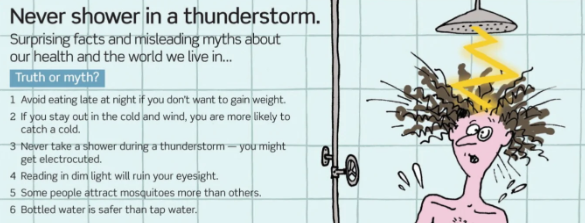
Look at some commonly-held beliefs related to health and medicine. Which ones do you think are true?
l = interviewer, Dr = doctorI: We have in the studio Dr. Linda Blakey, who is helping us separate the medical facts from all the myths and old wives' tales that are out there. So, my first question, Linda, is there any truth in the belief that if you eat a large meal in the evening, you're more likely to gain weight than if you eat the same amount of food earlier in the day?
Dr: Well, there's a clear answer to that: if you're watching your weight, what matters is what you eat, not when you eat it. A calorie at midday is no different from a calorie at midnight, and the idea that your metabolism slows down in the evening is actually a myth. As a matter of fact, there is a medical condition called "night-eating syndrome," which affects two percent of the population, and people who suffer from it eat very little during the day, but often wake up and eat during the night. These people on average are no more overweight than people who do not suffer from this syndrome.
I: So l can go out for a big meal in the evening and not feel guilty about it?
Dr: Absolutely - as long as you don't have a big lunch, too.
I: Well, that's good. The next question l'd like to ask you about is catching colds. It's always seemed obvious to me that if you stay out in the cold and wind, you're more likely to catch a cold. But l also remember reading somewhere that this was a myth. What's the truth about that one?
Dr: Well, colds, we know, are caused by viruses, which you catch from an infected person, for example, when they cough or sneeze. Now for many years doctors believed that the only reason why it was more common to catch a cold in the winter was because people stayed indoors more, and so they infected one another. But recent research has found that being exposed to cold temperatures does in fact lower our body's defenses, so that means that if you get cold, you're more likely to become infected by a cold virus, or to develop a cold if you've already been infected. It's not a myth, it's true.
I: OK. That all makes sense to me. Now something my parents used to tell me was that it's dangerous to take a bath or a shower during a thunderstorm, because I might get electrocuted. I've always thought it was crazy. Is it an old wives' tale?
Dr: In fact, that's actually true. Between ten and twenty people a year get an electric shock while taking a bath or shower during a thunderstorm, and some of them die as a result. It's due to the fact that metal pipes are excellent conductors of electricity, as is tap water. So even though statistically it's not very likely to happen to you, especially if you live in a grounded building, you should probably avoid showering during a storm.
I: OK. I'll remember that! Now the next one is something I'm they can read perfectly well. But reading in dim light must be bad for their eyes, right?
Dr: Well, that's one that parents around the world have been telling their children for generations, but it actually has no real scientific basis. Reading in the dark or in dim light can cause a temporary strain on the eyes, but it quickly goes away once you return to bright light.
I: Well, now I know. Now the next one affects me directly. Every summer in the mosquito season, I get really badly bitten, even when 1 put insect repellent on, but my wife never gets bitten at all. She says that mosquitoes don't like her. Is that possible?
Dr: It's irritating, isn't it? As a matter of fact, it seems to be true. Female mosquitoes, which are the ones that bite, are attracted to the carbon dioxide we exhale, our body heat, and certain chemicals in our sweat. But some lucky people produce chemicals that either prevent mosquitoes from detecting them or that actually drive them away. Unfortunately, I'm not one of those lucky people either, but your wife obviously is.
I: The last thing I would like you to clarify for us is the idea that bottled water is purer than tap water. Now I know it's one thing to drink bottled water if you're traveling in a country where the water hasn't been treated or isn't safe to drink. But what about here in the United States?
Dr: We're all a bit suspicious of what comes out of our taps, and that's why sales of bottled water have risen so much over the last decade. But what many people don't realize is that bottled water isn't subjected to the same regular testing that tap water is, and in some tests a third of the samples of bottled water analyzed were contaminated. In any case a quarter of all bottled water sold is just filtered tap water.
🎧 Listen to the audio